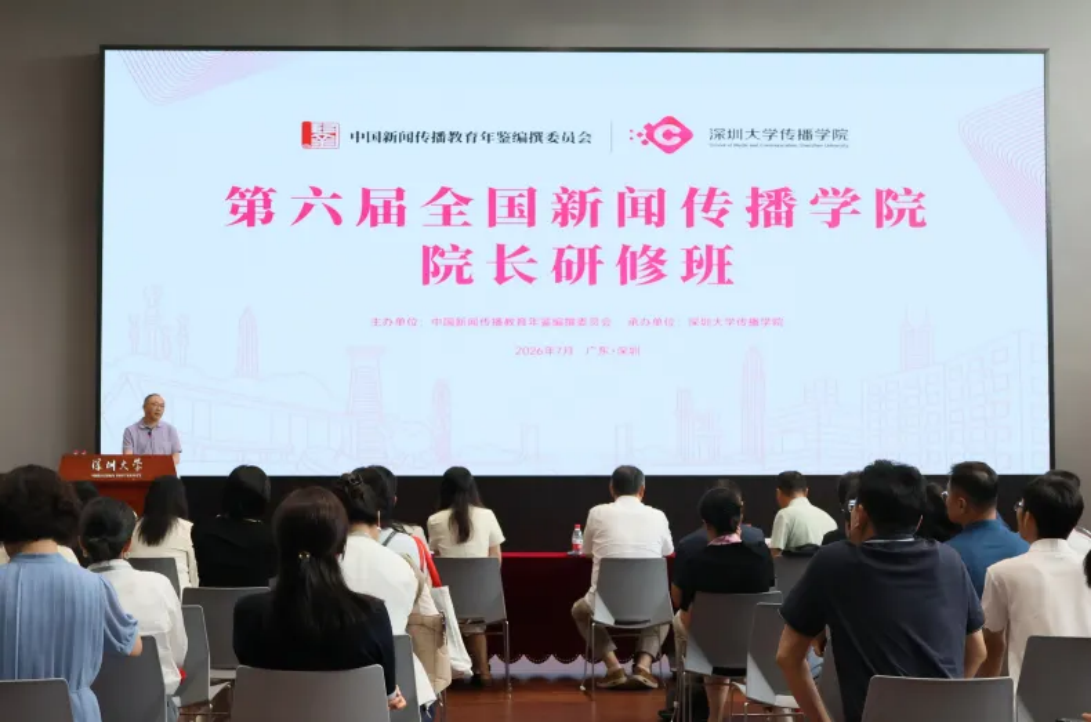
The Sixth National Advanced Training Program for Journalism and Communication School Leaders concluded at Shenzhen University on July 21, bringing together more than 100 deans, department heads and academic leaders from universities across China for six days of intensive learning, discussion, and field visits.
Hosted by the Editorial Committee of the China Journalism and Communication Education Yearbook and organized by the School of Media and Communication (SMC) at Shenzhen University, the program featured 11 expert lectures as well as study visits to Shenzhen Press Group, Huawei, Tencent, and Shenzhen University’s State Experimental Teaching and Learning Demonstration Center for Media and Communication.
At the closing ceremony, participant representatives reflected on the program and shared their insights. Professor Rui Geng, Dean of the School of Journalism and Communication at Beijing Institute of Graphic Communication, highlighted three aspects of the program experience: intellectual inspiration, hands-on industry engagement, and meaningful peer exchange. She noted that the field visits offered participants a firsthand look at the transformation of mainstream media and the growing impact of digital technologies on the media and communication industry.
Professor Rongting Zhou, Executive Director of the Department of Science Communication at the University of Science and Technology of China, summarized his experience around three themes: “direction, methods, and confidence.” He said the program offered practical insights into academic planning, disciplinary development, international communication education, and the transformation of media education in the age of artificial intelligence. He also pointed to the growing convergence of science communication and intelligent communication as a promising area for future exploration.
Following the participant addresses, Professor Kun Zhang, Director of the Editorial Committee, presented completion certificates to participant representatives.
Professor Shengdong Lin, Dean of Xiamen University’s School of Journalism and Communication, accepted the certificate authorizing Xiamen University to host the next program on behalf of the institution. He said this year’s program had effectively connected academic discussion with industry engagement, while drawing on Shenzhen’s strengths in media and technology. Xiamen University, he added, would build on this experience while incorporating its own academic strengths and regional resources into next year’s program.
Professor Guang Yang, Acting Dean of SMC, congratulated participants on completing the six-day program and thanked the Editorial Committee, speakers, partner organizations, organizing team, and student volunteers for their support. She expressed hope that the discussions and industry insights gained during the program would translate into new approaches to disciplinary development, curriculum reform, and talent cultivation across participating institutions.
In the closing address, Professor Kun Zhang highlighted the program’s strong focus on the real-world challenges facing journalism and communication education. By combining expert lectures with visits to leading media and technology organizations, he said, the program placed media transformation, technological innovation, and talent development within the same learning process and encouraged closer ties between universities and industry.
Earlier that morning, participants joined four group discussions on disciplinary development and talent cultivation, sharing practices and challenges from their own institutions. With the conclusion of the closing ceremony, the six-day program officially came to an end, with participants looking ahead to the next gathering in Xiamen.