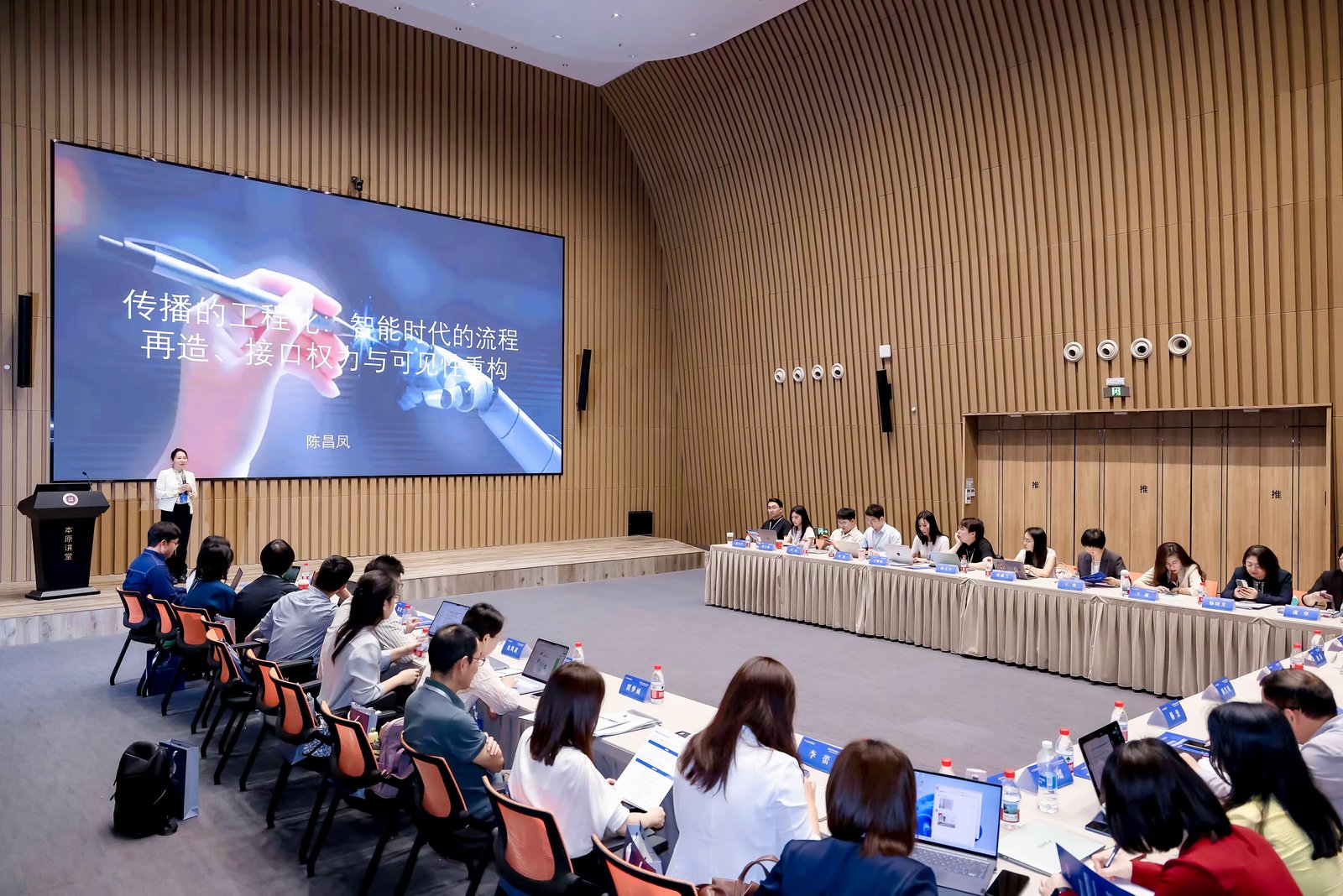
The Fifth China Digital Journalism Annual Conference was held at Shenzhen University from May 16 to 17, 2026. Co-hosted by the School of Media and Communication (SMC) at Shenzhen University and the academic journal Journalism and Mass Communication (Xinwenjie), the conference was organized by the university’s Institute of Global Communication Studies and the Center for Convergent Global Communication. The event was initiated by Jiang Chang, Executive Dean of the Institute of Global Communication Studies and chief expert of the National Social Science Fund Major Project Research on the Theory, Methods, and Practice of Digital Journalism.
Centered on the theme “Digital Journalism Knowledge Innovation in the Age of Intelligent Media,” the conference explored the theoretical, methodological, and ethical transformations arising from AI-driven changes in news production and communication. More than 40 scholars from over a dozen leading universities, including Tsinghua University, Fudan University, Renmin University of China, Zhejiang University, Nanjing University, Wuhan University, Xiamen University, Minzu University of China, Jinan University, and Communication University of China, participated in the event. Editors and representatives from ten major CSSCI-indexed journals also attended, underscoring the conference’s growing influence within China’s journalism and communication research community.
The conference opened on the morning of May 16 with a welcome address by Naipeng Chao, Vice President of Shenzhen University. He highlighted the profound impact of intelligent technologies on news production and communication, emphasizing the need for new theoretical perspectives and knowledge frameworks to address these far-reaching transformations. He praised the China Digital Journalism Annual Conference as a leading platform for research exchange and expressed his hope that the discussions would generate new insights for developing an independent Chinese knowledge system of digital journalism.
Guang Yang, Acting Dean of SMC, then highlighted the School’s ongoing efforts to advance academic research and knowledge development in journalism and communication. She emphasized the School’s commitment to bridging theoretical innovation and professional practice in the AI era.
The keynote forum featured presentations by leading scholars including Changfeng Chen, Tao Liu, Chenyao Wang, and Guang Yang. Their presentations covered topics ranging from intelligent agents and transparency in digital storytelling to AI ethics in journalism and the evolution of China’s online content governance.
In the afternoon, participants joined parallel panel discussions organized around four themes: intelligent media, digital news ecology, journalism culture, and technological transformation. Scholars exchanged views on emerging issues such as AI-generated journalism, news avoidance, visual communication, and digital news ecosystems, reflecting the expanding scope and increasingly interdisciplinary character of digital journalism research.
Initiated by Jiang Chang as part of the National Social Science Fund Major Project, the China Digital Journalism Annual Conference has grown into an important academic platform for digital journalism research in China. This year’s conference further advanced scholarly dialogue on building an independent Chinese knowledge system of digital journalism and enhanced Shenzhen University’s academic visibility and influence in the field.