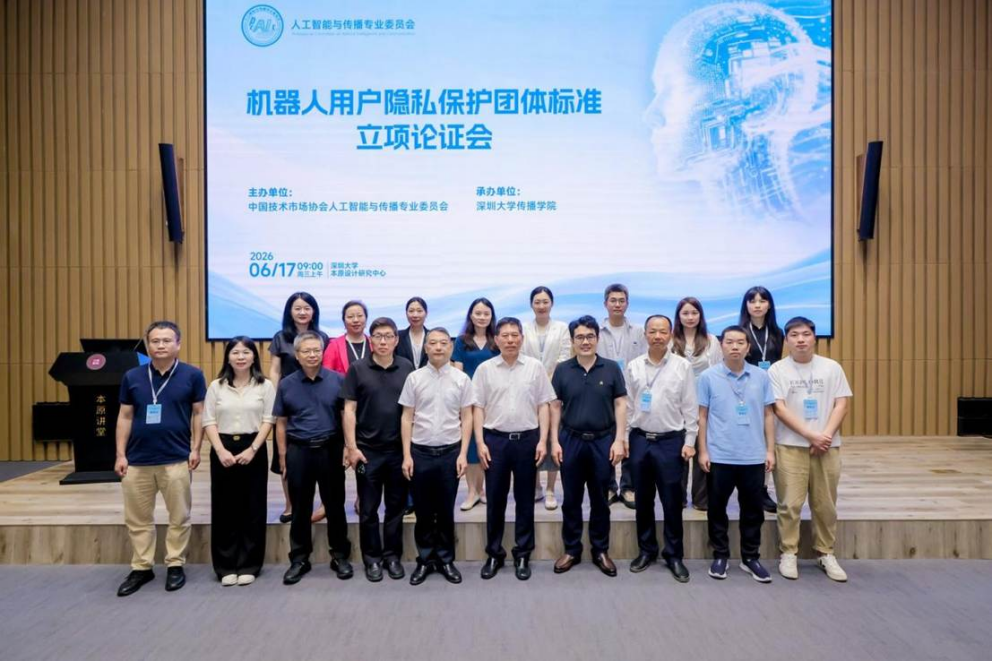
On June 17, 2026, a proposal review meeting for the Robot User Privacy Protection Standard was held at Shenzhen University. Hosted by the Professional Committee on Artificial Intelligence and Communication of the China Technology Market Association (CTMA) and organized by the School of Media and Communication (SMC), Shenzhen University, the meeting concluded with the expert panel’s approval of the proposal, formally launching the development of China’s first association standard dedicated to robot user privacy protection.
The meeting was attended by CTMA President Xianwu Yang and Vice President Bing Wang, and was chaired by Professor Guang Yang, Acting Dean of SMC and Executive Council Member of the Professional Committee on Artificial Intelligence and Communication.
At the meeting, President Yang emphasized the importance of timely standards in responding to rapid technological change. As AI-powered robots become increasingly integrated into everyday life, he noted, clear guidance is needed to manage potential risks while supporting responsible innovation.
Vice President Wang drew particular attention to the privacy challenges posed by service robots, which can continuously collect information through cameras, microphones, sensors, and other interfaces. He called for stronger safeguards for sensitive data, including emotion-related information, as well as enhanced protections specifically for children, older adults, and other vulnerable users.
Professor Yunze Zhao, Chair of the Professional Committee, outlined the development of the proposed standard. He noted that technologies such as facial recognition, voice interaction, behavioral analysis, and emotion sensing are creating new privacy risks in human-robot interaction. The standard is therefore designed to clarify the boundaries of data collection and use, strengthen user protection, and promote responsible industry practices. More than 40 member institutions have participated in the drafting process, including over 30 universities as well as leading technology and robotics companies such as iFLYTEK and Noetix Robotics. The draft has undergone five rounds of revision.
Professor Huanping Peng, Executive Chair of the Committee and Dean of the School of Journalism and Communication at Hebei University, introduced the overall framework of the standard. Other participating experts from journalism and communication, law, computer science, and the robotics industry offered recommendations on issues including consent mechanisms, privacy risks in domestic environments, voice and environmental data protection, local and cloud-based data storage, anonymization, data erasure, and the balance between personalized services and privacy protection.
Following deliberation, the expert panel unanimously approved the proposal. The panel noted that the standard provides a forward-looking framework for the collection, storage, use, transmission, and deletion of personal information throughout the lifecycle of service robots.
The initiative represents an interdisciplinary effort to strengthen privacy and ethical safeguards for rapidly evolving AI technologies and to promote safer, more trustworthy human-robot interaction.