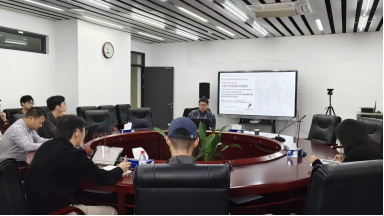
On the morning of December 23, 2025, the School of Media and Communication hosted an academic lecture titled “From Mediatization to Infrastructuralization—A Theoretical Shift in European Media Research and Its Insights.” The lecture was delivered by Dr. Jun Liu, Associate Professor at the Department of Communication, University of Copenhagen, Denmark. Faculty members and students gathered for this engaging event, which was both richly informative and thought-provoking.
Prof. Liu opened the lecture by introducing the core concept of mediatization, defined as the process through which media deeply penetrates society, forming an integral part of institutional operations and everyday life. He explained that this concept is rooted in German and Nordic scholarly traditions, emphasizing how media logic can structurally shape political, cultural, and social processes. He then reviewed several major European schools of mediatization research, comparing their differing perspectives on the nature of media, units of analysis, and research methods.
Moving into the digital era, Prof. Liu focused on the rise of the “platform society” and introduced the idea of an “infrastructural turn” in media research. He explained that digital infrastructure encompasses not only technical components such as data centers and algorithms, but also societal and political-economic dimensions, including platform governance and data exploitation. He argued that social reality is becoming tightly interwoven with digital platforms and the technological frameworks beneath them. He outlined several emerging trends that characterize this new stage of media evolution, including real-time data processing, continuous platform iteration, and the transformation of infrastructure into a medium.
In the Q&A session, participants engaged Prof. Liu in discussions ranging from how European theories might inform Chinese media research and practice to the challenges of governing digital infrastructures in society. He noted that the theoretical turn from mediatization to infrastructuralization offers a renewed lens for understanding the media–society relationship and provides valuable insights for scholars examining China’s rapidly evolving digital landscape. Overall, the lecture systematically mapped the frontiers of contemporary European media research and offered both theoretical inspiration and practical insights.