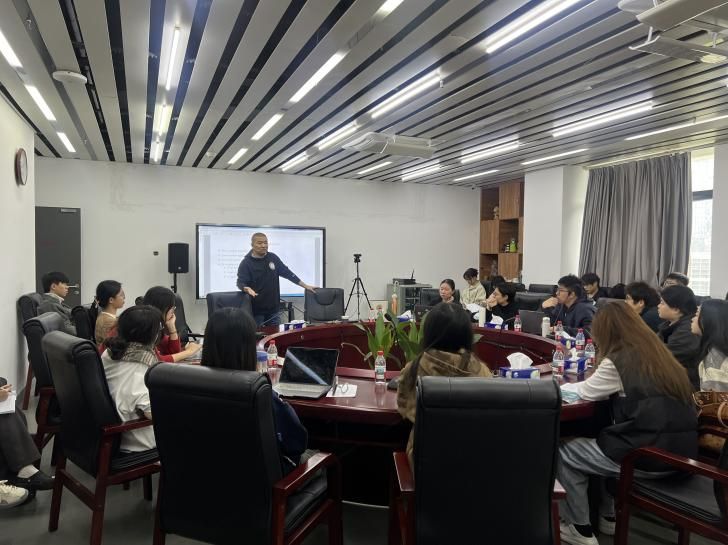
On November 20, 2025, the School of Media and Communication hosted an academic lecture titled “Studying Communication with AI—and Studying Communication with AI in It.” The keynote speaker, Professor Winson (Tai-Quan) Peng from the Department of Communication at Michigan State University, delivered an insightful talk that attracted a strong turnout of faculty and students. The lecture was moderated by Assistant Professor Yi Wu, Associate Director of the Department of Journalism.
Professor Wu opened the event by extending a warm welcome to Professor Peng and introducing his distinguished academic background. Professor Peng’s research spans computational social science, health communication, political communication, and mobile analytics. He has published more than 70 articles in highly ranked SSCI and SCI journals and currently serves as Editor-in-Chief of Human Communication Research while holding editorial positions in several other internationally recognized publications.
In his lecture, Professor Peng addressed two major themes: using AI as a tool in communication research and understanding AI as a participant in communication processes. In discussing AI as a research tool, he explained how large language models (LLMs) can enhance research efficiency in tasks such as content analysis and counterfactual modeling, while also raising concerns related to measurement reliability and semantic drift. He emphasized the importance of methodological caution—including human validation and multi-model approaches—when integrating AI into academic research. Shifting to AI as a participant in communication, Professor Peng further discussed how AI’s growing involvement in message production and interaction challenges traditional communication models and complicates the attribution of communication effects.
During the Q&A session, students and faculty engaged in a lively discussion on human–AI interaction and the changing pathways of information access. The lecture offered timely insights into the evolving landscape of AI-mediated communication and encouraged the audience to reconsider fundamental questions in contemporary communication research.